Saturday, 23 September 2017

Using Megagames To Unlock The Future

All quiet on the Taiwan front!
I was recently asked to act in an analyst role in a megagame undertaken by professional wargamers. Normally I would participate as a player, but this invitation gave me an opportunity to stand back and consider the use of megagames as a technique to generate stories about the future. The game we played was 'Dire Straits', a megagame set at the beginning of 2020, that sought to explore some of the diplomatic and military possibilities that might unfold in East Asia at that point in time.

A megagame is a non-linear representation of a complex system in which the actors interact to generate a narrative about a future state. In Dire Straits, we had about 120 players, representing most of the nations on the Indo-Pacific axis, advancing what they thought to be their national interests. The game wasn't at all deterministic, which allowed the players to roam over any form of policy option. It is satisfying that, in the scenario generated, war didn't result. However, in a number of flashpoints the participants moved up to the jump point, but then backed away again. This had a refreshingly familiar ring to it.

In considering why we might want to use megagames as a tool for unlocking the future, five analytical points came to mind:

  1. A ‘game’ represents a ‘system’. In the case of Dire Straits, the system being represented is the web of international relations in East Asia and beyond. This compels us to think systemically about international relations.
  2. If we have a system, then we will need actors to operate the system. This compels us to identify the key actors within the system and their motivations to act within the system.
  3. The system consists of a series of relationships between the various actors. The game compels us to define the relationships between the various actors and examine the modes by which they interact with each other.
  4. The interactions between the actors permits us to examine the strategies they adopt in their interactions. The game compels us to adopt a strategy to play the game and to monitor the outcomes of the strategies adopted
  5. From a systemic perspective, this then opens the possibility of wind-tunnelling various potential strategies from within the game framework. This can be used to identify, consider, and experiment with various policy options. 
It is my view that megagames are a valid tool for generating future narratives. They are best suited to large questions because, as a technique, they are not an inexpensive exercise. By definition, they involve a large amount of staff time. In order to yield interesting results, they need to be conducted several times. However, they can provide a way to cut through the complexity that is inherent in many systems. 


Stephen Aguilar-Millan

© The European Futures Observatory 2017

Monday, 4 September 2017

Putin Rolls The Dice ... And Throws A Six

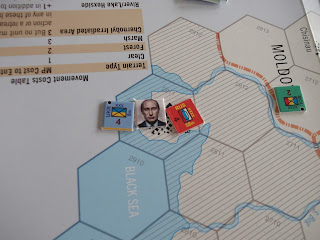
The Russian victory parade in Odessa.
We previously wrote about the game 'Putin's War', and how it might be pulled apart and reconstructed as a multi-player game which could be used to examine some of the issues affecting Russia's neighbours in the near future. We were recently given an opportunity progress this idea at a gaming conference. 

One of the aspects of the vanilla game that sat awkwardly for us was the uniformity of the Blue team. To recap, the Blue team contained both Russia's neighbours (the Baltic States, Belarus, and Ukraine), along with a selection of other nations within eastern Europe. We wanted to split this team into something that more closely resembled the current state of affairs.

In the vanilla game, the United States does not play a large part because of the logistics of sending a significant force to eastern Europe in a short space of time. We wanted to model this differently. We added a political game to the vanilla game that included the process by which Article 5 of the North Atlantic Treaty is invoked, adding delay upon delay before America could engage in operations. For the United States to become involved, Article 5 needs to be invoked, the North Atlantic Council needs to approve action, and Congress needs to ratify the decision for action. In a game modelling 30 days, the potential for delay is significant.

We didn't want to ignore recent developments in Europe either. As the United States appears to be lessening it's commitment to the defence of Europe, the European Commission is developing a Common Security and Defence Policy outside of the NATO structure. We wanted to give that a fair wind and to incorporate that idea into the game. The European arrangement organises member states into various battlegroups. We decided to use two such battlegroups - the Nordic Battlegroup (Estonia, Latvia, Lithuania, Sweden, and Finland) and the Visegrad Battlegroup (Poland, Hungary, Slovakia, and the Czech Republic). The battlegroups would only be activated once the Common Security and Defence Policy is activated. This would come after the North Atlantic Council approved the invocation of Article 5, and required the approval of the European Council of Ministers.

As the United States appears to retreat from the defence of Europe, Germany naturally becomes more important in that defence infrastructure. Germany was represented by a single player, whose brief was to maintain the rating of the 10 Year Bund. We added a little financial aspect to the game, modelling the impact of conflict in eastern Europe on the bond market. 

Two further key elements to the Blue team were Ukraine and Belarus. Not part of NATO, not part of the EU, already a victim of Russian aggression, Ukraine occupies a difficult position. We structured the game so that the Russian players could focus their attention on Ukraine without the direct intervention of NATO and the EU. We did try to encourage a little bit of Polish adventurism through the occupation of Ukrainian territory. Belarus, on the other hand, sat between the two sides. In reality, Belarus tries to maintain good links with both NATO and Russia. By assumption, we inserted a neutral Belarus into the game. We could equally have included Belarus in either the Blue team or, more realistically, the Red team. It would be interesting to run the same game three times, each with a different assumption about Belarus.

Although we talk of the Red team, this is actually Russia. We wanted to make Russia less monolithic, so we spilt the team into two - the Southern Military District and the Western Military District. Following current deployments, the intended focus of the Southern Military District would be Ukraine and the focus of the Western Military District would be the Baltic States. We gave the Red team players the opportunity to play co-operatively or competitively with each other. The mechanism for this was the allocation of action points and the allocation of reinforcements from the Central and Eastern Military Districts.

The briefing to players was:

The purpose of the game is to consider how eastern Europe could look if the Russian Federation were to take military action to restore a land buffer between itself and the European NATO nations. By assumption, the scene is set for the spring of 2020. Europe has been through a series of acrimonious negotiations over Brexit, with the various Member States arguing over the post-Brexit landscape. President Macron has failed to re-vitalise France, leaving Germany the undisputed dominant force in the EU. The people of Europe responded by voting heavily for Eurosceptic politicians in the European elections of 2019. On the other side of the Atlantic, the US Presidential elections are under way, with the incumbent polling well on an ‘America First And Only’ platform. Meanwhile, there are reports of large troop movements in the Russian Federation …

The game unfolded more or less as we expected it to. The Russian players acted co-operatively and decided to focus on the occupation of Ukraine. The reinforcements were allocated to the Southern Military District and the area of Significant Ethnic Russian Population in Ukraine was occupied in the first turn. In a single move, the state of Malorossiya came into being. There was little response from the Blue team. As Ukraine is not part of NATO, it cannot start the process of invoking Article 5, which also means that the Common Security and Defence Policy could not be invoked. In terms of the game, Ukraine acts alone.

That did beg the question that if this would prove so easy, why hasn't it happened already? I think that the answer to that question highlights the weaknesses of gaming as a technique to view the future. All sorts of assumptions were made in the game about the behaviour of the players (which were written into the rules) and other key nations who weren't players (China springs to mind here). These assumptions are worth teasing out. For example, what if the United States, outside of the framework of NATO, had armed and trained the Ukrainian forces, making them much more effective than originally thought? What if western sanctions had caused far more caution on the part of Russia? What if Russia feared the possibility of a more adventurous Chinese response in Central Asia? None of this was covered in the game, but in real life it has to be taken into account.

We allocated an hour and a half to the game. This wasn't long enough. During that time, we only managed to brief the players on the game mechanism, the political game, and the working aspects of the Bond Market. This left us time for just a single turn. It was a long turn, with quite a lot happening, but the action was confined to Ukraine. The non-Ukrainian Blue team players had little to do because the Red team players avoided the trap of involving NATO at an early stage. I quite liked this as a model of real action, but I accept that it didn't include the Blue team players as much as we had hoped that it might.

Looking to the future, I think that the experiment was sufficiently positive to continue with the game. We now know that it needs a good day to play through and that it has the potential to offer some useful insights into the near future history of eastern Europe. I believe that very few of the mechanisms need further tweaking, and that it would be good to roll it out over all of the ten turns to see how far it goes. All we need now is a group of willing volunteers and a venue.


Stephen Aguilar-Millan

© The European Futures Observatory 2017

Tuesday, 29 August 2017

Four Futures: Life After Capitalism

I am often astonished at the power of a really simple futuring technique - such as 2x2 matrices - to generate such interesting results. This book represents one such exercise. There are many of the conclusions that I don't agree with, there are some parts where I feel that the model is ill-defined, but the overall product is one that ought to commend our attention.

The basic premise of the book - that the liberal order established by the Washington Consensus has moved beyond it's shelf life. It's very difficult to argue against that belief. However, that in itself is uninteresting because it fails to consider what comes next. A futurist would keep one eye on what is likely to replace the Washington Consensus. This is what the author tries to do.

The analysis has two critical uncertainties - the axes of the 2x2 matrix - a world of hierarchy as opposed to a world of equality and a world of abundance as opposed to a world of scarcity. This gives rise to four possible worlds - equality with abundance, hierarchy with abundance, equality with scarcity, and hierarchy with scarcity. Underpinning each of these worlds are the twin issues of automation and climate change. These rather colour the approach to each of the futures.

Each future is characterised by the dominant features that the author believes will be apparent. Equality and abundance is characterised by communism. Not the Soviet communism to which we have become accustomed. More the communism described by Marx, where the state withers away and we can all live our lives in relative harmony. Many have described this rather utopian vision, but the author sees it as possible if the singularitarians and transhumanists are any where near correct.

Hierarchy and abundance is a different matter, however. In this case, automation leads to material abundance, but the protection of intellectual property rights leads to the benefits of automation accruing to only a few. The 1%, if you like. This scenario is dubbed as one of Rentism, as a fortunate minority benefits from the rents accruing to technology. These are 'Rents' in the Ricardian sense. In modern times, we would call this passive income.

The world of equality and scarcity is characterised as one of socialism. In this case, the scarcity of climate change has outweighed any benefits accruing from automation. However, the scenario has a sense that society sees itself as being in it all together, and the climate induced hardships are shared out on a widespread basis. There is a lot to commend this view of the future.

The final scenario - hierarchy and scarcity - is perhaps the darkest. The author labels this a world of exterminism. In this world there isn't enough to go round, and those at the top of the hierarchy secure the lion's share for themselves. It leads to a widespread reduction in population numbers, a scenario characterised by the dominance of security issues and, ultimately, genocide.

As with all futures, there are elements of each of these which are evident in the present. For example, one dimension of exterminism could be seen as the apparent indifference towards the poorer nations displayed by the richer nations. One could argue that the recent moves towards co-ordinated climate action represents a socialist solution - the pain is distributed amongst those most able to bear it. Equally, it could be argued that the world of Rentism is evident in the technology sector today, where the winner takes all, protected by barriers of intellectual property law. The world of communism is less evident today, but one could argue that the NHS exhibits elements of that world.

If each of the scenarios are present today, it is not unreasonable to take the view that elements of each scenario will be present in the future. In many respects, this is how we ought to approach 2x2 matrices. They highlight potential dominant themes rather than produce a specific blueprint for the future.

This is all to the good, but there were points at which I felt a little short changed. This was over both the critical uncertainties and the dominant issues. With a focus on two critical uncertainties - social relations and material abundance - I felt that the book missed more than it caught. For example, I would have liked to see more prominence for the mechanism of distribution (market based or centrally planned?) to complement the issues of social relations (ownership and control). I feel that the author missed something important here.

One major omission in the book was a time frame in which all of this was to happen. A sharper focus on this would, I feel, have shed better light on the dominant issues. For example, if the book had a time horizon of a couple of hundred years (it was sub-titled 'Life After Capitalism'), then perhaps climate change might not be a dominant issue because the climate damage would have already been done. Equally, in two hundred years time, ought our current concerns about automation seem quaint?
By not grasping the issue of time, the author opens himself to all sorts of challenges in the realms of dominant issues. I would imagine that most futurists would be able to identify five off the top of their heads (mine would be war, security, space exploration, the funding of public services, and the re-invention of humanity). By omitting a time frame, the author opens himself to the criticism that he ought to have talked about 'those' issues instead.

I quite liked the book. It is short and to the point. It is readily readable. The author has an engaging style of writing which makes the prose just flow along. It is an important work on an important topic that is not a hard read. If only academic texts could follow this lead.

Stephen Aguilar-Millan

© The European Futures Observatory 2017

Wednesday, 16 August 2017

Peak Boomer

One of the features of contemporary society is that it is ageing. What this means in practice is that the percentage of older people as a proportion of the total population is rising. It is cited as the cause of the current pressure on health systems in Europe and North America. Adult social care is absorbing more and more resources in what appears to be a bottomless pit of open ended commitment. The unfunded pension promises made to the elderly population threaten to beggar public finances over the course of the next decade. This cannot continue indefinitely. At our spring retreat we decided to look at this issue a bit more closely.

Most of those people who are now entering the ranks of the elderly are those who were born in the 'Baby Boom' after 1945. They are a large and significant generational cohort and have been the subject of much analysis over the years. From a demographic perspective, they are reasonably easy to predict as much of their behaviour exhibits a shared experience. It helps being a 'Boomer' myself.

The growth of this cohort amongst the ranks of the elderly (which we have defined as aged 65+ - the old state retirement age) can be easily predicted from the existing demographic data. According to ONS data, the proportion of the population of the UK aged 65+ was 15.9% in 2004, rose to 17.7% in 2014, and will rise to 19.9% in 2024 and 23.3% in 2034. Age UK forecasts this group to be 24.2% in 2040. We have defined the point at which the growth of this cohort slows as being 'Peak Boomer', and, on current projections, we estimate it to be in the period 2035-40.

There are a number of factors that might blow this estimate off course. The most significant one is that the death rate has risen since 2015. This might be a temporary blip, but it could portend something far more significant. Social progress in the UK, as measured by a falling death rate, has advanced at a fairly steady since 1919. Signs of this changing were evident in 2010, when the death rate started to level out, and from 2015 it has risen.

The causes of the rising death rate are many, but the prime suspect is the political austerity imposed by the Coalition Government from 2010. Financial constraints hemmed in spending on the NHS, just at the point when the demands placed upon it started to rise. The reduction in local authority funding from 2010 has actually shrunk adult social care provision across England. The rise in demand for dementia and Alzheimer's care have outpaced the capacity deal with it. It has to be said that there are cross currents here. Cancer survival rates are at record highs. The Boomers, as a cohort, smoke less and exercise more than their parents, leading healthier lifestyles. It could be that the death rate starts to fall again, but this worsens the situation for care rather than eases it.

The estimate of Peak Boomer at 2035-40 has the right feel to it. If it is correct, then that would have a number of important consequences. To start with, the pinch upon public finances is set to last another generation. Pensions are still unfunded, social care is still inadequately financed, and the demand for services is set to rise for a further generation. Good news for care homes but bad news for taxpayers. There is very little incentive to introduce significant changes because the electorate - dominated by Boomers as voters - will punish those politicians who suggest doing so, as the recent fiasco over the 'Dementia Tax' demonstrates.

There are, however, far more subtle, and malign consequences of Peak Boomer. The August 2017 inflation report from the Bank of England highlights the historically low savings ratio (at 1.7%, it has not been this low since 1956). Part of this is explained by households protecting their living standards in the face of a fall in disposable income (inflation is increasing and wages stagnant), but part of this is explained in generational terms as Boomers use their savings to fund their lifestyle in elderhood and the Millennials find it hard to save owing to the squeeze on their living standards. This is a bit of a cartoon approach to stylise the situation, but it has more than a grain of truth.

The consequence of this is that the pool of savings to fund business investment, if not provided domestically, will have to be provided internationally. The corollary to the record trade deficit are record inflows on the capital account. More and more of the UK is owned abroad. Sadly, this money is being used to fund unproductive assets, such as high end property in London, rather than productive business assets to generate future growth.

And that is where we are today. There is little to suggest that the 'Age of Stagnation' will end in a hurry. In the absence of any systemic changes, our current malaise is likely to continue for some years to come.


Stephen Aguilar-Millan

© The European Futures Observatory 2017

Thursday, 10 August 2017

The Implosion Of China

The rebels and Taiwanese secure South China
and cross the Yangtze.
Our little study group recently considered the question of the implosion of China as a state. This may sound a bit odd at first, but it does have some foundation and is a potential future that is worth thinking about. China, as a national entity, has been around for thousands of years. During this time, it has waxed and waned, it has grown and it has shrunk. It has been subjugated and it has conquered all before it. China, as we currently understand the political entity to be, has been in existence only since 1949. It would be wrong to assume that the current boundaries are entirely stable, given the perspective of thousands of years.

We have written before about the boundaries of China expanding. It is now time to think about the possibility of the boundaries of China contracting. There is a certain method to this way of thinking. It was a nineteenth century Chinese historian, Wei Yuan, who first identified a series of cycles which Chinese politics appears to follow. Starting arbitrarily in the cycle at a period of 'chaos and humiliation' (the quru), this is followed by a period of 'rejuvenation' (fuxiang), and then followed by a period of 'wealth and power' (fuqiang), before returning to a period of quru again. The narrative is that the nineteenth century represents a period of quru, the Communist revolution and the post-Mao reforms represent a period of fuxiang, leading to the current situation of fuqiang. If any of this is true, then the future of China will be one of continued fuqiang, followed by a period of quru. It is this boundary between fuqiang and quru that interests us.

The question of how to tackle this came into focus when we came across the magazine 'Modern War 19'. It contains a nice article on the subject, but more importantly, a game by Ty Bomba to frame the scenarios. As always, we started by playing the vanilla game to see how things might work out. In the run through, the Rebels took the opportunity to place their capital in Hong Kong and to work outwards from there. I thought this to be a nice touch because of all the places where a revolt might originate, South China has to be at the top of my list. In the run through, the rebel forces enlisted the support of Taiwan and drove most of the government forces back north of the Yangtze River.

It was an interesting game, but really does need some modifications. To start with, the forces of Taiwan are over-estimated. I think that we may clip their wings in future run throughs. I wasn't at all comfortable with a scenario set that just had two sides. I think that future games ought to be set at the level of the Military Region, with the politics set to invite the players to set themselves up as modern day warlords and fragmenting China on a regional basis. They could have a degree of autonomy within their regions and compete over the distribution of resources, a political mechanism that has to be added to the game. We could almost pose the game as one of regionalism against nationalism. We also need to work on a mechanism which induces the various regions to rebel against Beijing. The bond market might be a likely place to spark a sequence of events leading to civil disorder. It is certainly a point at which the prosperous coastal regions might baulk at subsidising the less prosperous inland regions.

The game still has a lot to offer in an area which is not widely considered. It is on our agenda to develop a series of scenarios around the disintegration of China in the coming months.


Stephen Aguilar-Millan

© The European Futures Observatory 2017

Saturday, 5 August 2017

Living With Climate Change

A recent edition of New Scientist contained a special report on the theme of how to live with climate change and how to beat it. I thought this an interesting development in how we approach climate change. Previously, climate change has been treated as something which is avoidable, if only we can act to prevent it. This series changes the base assumption. It starts from the premise that disruptive climate change will happen, and works towards the consequences of it happening. The special report certainly had my attention.

The special report consisted of seven pieces, with a number of side boxes, that set out the basic case. The first article - 'The New Normal' - establishes a number of speculations about what the climate would be like if the earth were to be appreciably warmer. For example, we can expect spring to begin earlier than it has in the past, or that nights are warming faster than days. These all act in conjunction with natural swings in weather patterns, and it is too early to discern which are due to human activity and which are due to natural variation that would have occurred in any case.

The second piece ('Can We Limit Warming To 2˚C?') and third piece ('Is Runaway Change Likely?') are essentially different sides of the same coin. The second piece outlines what it is that we will need to do in order to limit warming to 2˚C. It seems to be a tall order given that it would require unprecedented levels of international co-operation and an unprecedented commitment of resources. If we do nothing, the article forecasts temperature rises of 3˚C to 5˚C, relative to 1850-1900, by the end of the century. That then begs the question as to whether runaway climate change is likely. The third piece addresses this question, and suggests that it is probably too early to tell. There is much about the climate that we don't know, and this is one of those points at which we are pressing the boundaries of our knowledge.

We are, however, not doing nothing. The fourth piece asks 'Have We Reached Peak Emissions?' This is an interesting question. It does suggest, with an evidential base, that the carbon intensity of our economic activity has started to plateau. The developed economies are polluting less, and the emerging and developing economies are moving to green technologies without an intermediate phase of using fossil fuel technologies.

The fifth ('How To Cope In A Warmer World'), sixth ('Will We Have To Geoengineer?'), and seventh ('Can I Make A Difference?') pieces move on to address the consequences of disruptive climate change. In short, we are urged to cope with a warmer world by a more vigorous process of risk assessment, we don't really have the technology to Geoengineer at present, and we can make a difference, but very few of us choose to do so. We are quite comfortable in our existing way of doing things, and we are resistant to change our ways.

I found the special report disappointing. I was hoping for a deeper analysis than I received and I was hoping for a greater focus on the consequences of disruptive climate change. I do think that it would be an interesting exercise to consider what the consequences of, say, a 5˚C warming might be, and then to consider how we might live within that constraint. I see this as an important piece of work because, armed with these ideas, we could then assess what technologies we will need in the future but presently don't have, and then deploy investments into attaining those technologies.

We are currently stumbling along in the hope that something may turn up to ease the climate pressure, but it may turn out that is a future without us. If we don't like that possibility, then we might like to do something to change it. I'm afraid that this special report doesn't really help us in this task.


Stephen Aguilar-Millan

© The European Futures Observatory 2017

Wednesday, 2 August 2017

Brexit In A Single Picture

This picture, which appeared in The Economist of July 29th 2017 under the title 'Northern Uproar' (p. 24 UK edition), caught my attention because it explains the Brexit vote in England in a single picture. The picture shows that public transport investment spending per capita between 2016 to 2021 in London is roughly the same as that for the rest of England combined. It shows how skewed transport investment is towards London. Other areas feel that they are not receiving their fair share of the cake. This story is repeated across the public sector. It is the same for schools, social services, the NHS, elder care, and housing. It helps to foster the belief that the regions are being left behind. This is where the people left behind live.

It is really toxic. The benefits of globalisation have been enjoyed by London over the past two decades, whilst the regions have been allowed to decline. Some politicians have talked about regional renewal, but not a great deal has been delivered. We are now in a position where a good part of the costs of Brexit will fall disproportionately upon London - especially in the financial services sector - much to the indifference of the rest of England.

We should note that the chart shows future spending plans as well as past expenditures. If it remains as it is, then the divide between London and the rest of England will simply increase. Ordinarily that would not matter too much, but as the regions have recently discovered, there are more voters living in regional England than there are living in London.

Now that muscle has been flexed, can we expect more surprises like Brexit?

Stephen Aguilar-Millan

© The European Futures Observatory 2017